• Home
  • Explore Resources
    • Clinical
    • Scientific
    • Regulatory
    • Regulatory Links
  • Spotlight Topics
    • Potency Matters
    • Key Characteristics
  • About Us
  • Home
  • Explore Resources
    • Clinical
    • Scientific
    • Regulatory
    • Regulatory Links
  • Spotlight Topics
    • Potency Matters
    • Key Characteristics
  • About Us
  • Home
  • Explore Resources
    • Clinical
    • Scientific
    • Regulatory
    • Regulatory Links
  • Spotlight Topics
    • Potency Matters
    • Key Characteristics
  • About Us
Does GLP enhance the quality of toxicological evidence for regulatory decisions

Does GLP enhance the quality of toxicological evidence for regulatory decisions

by Michael Boyd | Jul 25, 2023 | Publications

A group promoting the importance of non-monotonic dose responses for endocrine disruptors contend that scoring systems giving primacy to GLP are biased against non-GLP studies from the literature and are merely record-keeping exercises to prevent fraudulent reporting...
Evaluating Uncertainty to Strengthen Epidemiologic Data for Use in Human Health Risk Assessments

Evaluating Uncertainty to Strengthen Epidemiologic Data for Use in Human Health Risk Assessments

by Michael Boyd | Jul 25, 2023 | Publications

There is a recognized need to improve the application of epidemiologic data in human health risk assessment especially for understanding and characterizing risks from environmental and occupational exposures. Although there is uncertainty associated with the results...
Interpreting Estrogen Screening Assays in the Context of Potency and Human Exposure Relative to Natural Exposures to Phytoestrogens

Interpreting Estrogen Screening Assays in the Context of Potency and Human Exposure Relative to Natural Exposures to Phytoestrogens

by Michael Boyd | Jul 25, 2023 | Publications

To place endocrine screening results in the context of potency and human exposure, we propose a method that entails (1) calculating a benchmark dose for a response measured in an endocrine screen; (2) estimating the human urinary concentration (biomonitoring...
Key Learnings from the Endocrine Disruptor Screening Program (EDSP) Tier 1 Rodent Uterotrophic and Hershberger Assays

Key Learnings from the Endocrine Disruptor Screening Program (EDSP) Tier 1 Rodent Uterotrophic and Hershberger Assays

by Michael Boyd | Jul 25, 2023 | Publications

In 2009, companies began screening compounds using the US Environmental Protection Agency’s Endocrine Disruptor Screening Program (EDSP). EDSP has two tiers: Tier 1 includes 11 assays to identify compounds with potential endocrine activity. This article...
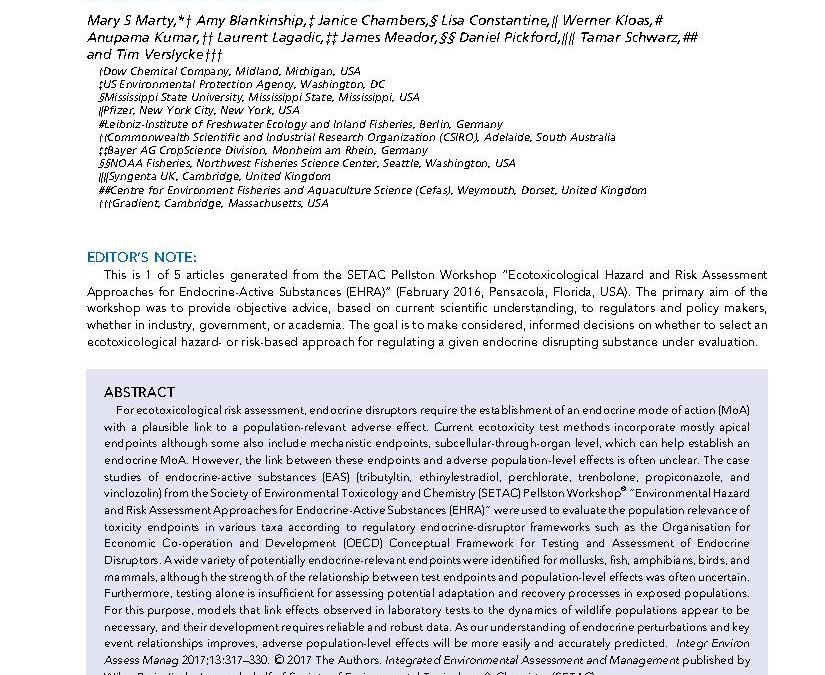
Population-Relevant Endpoints in the Evaluation of Endocrine-Active Substances (EAS) for Ecotoxicological Hazard and Risk Assessment

Population-Relevant Endpoints in the Evaluation of Endocrine-Active Substances (EAS) for Ecotoxicological Hazard and Risk Assessment

by Michael Boyd | Jul 25, 2023 | Publications

A wide variety of potentially endocrine-relevant endpoints were identified for mollusks, fish, amphibians, birds, and mammals, although the strength of the relationship between test endpoints and population-level effects was often uncertain. Furthermore, testing alone...

« Older Entries
Next Entries »

Recent Posts

  • Webinar 2: THE KEY CHARACTERISTICS APPROACH – A Mechanistic Misfit?
  • Webinar 1: The Key Characteristics Approach – Fit For Purpose
  • Endocrine Policy Forum website created

Recent Comments

    Archives

    • March 2026
    • October 2017

    Categories

    • Issue Analysis
    • Pamphlets
    • Presentations
    • Publications
    • Spotlight Topic
    • Uncategorized
    • Videos

    Meta

    • Log in
    • Entries feed
    • Comments feed
    • WordPress.org

    Contact Us

    The EPF welcomes your input and questions.